Continuous Line Design of a Boy: Mastering Minimalist Art for Digital Projects
The allure of minimalism lies in its ability to convey complex emotion and form through the simplest possible means. A continuous line design of a boy captures this essence perfectly, reducing a human figure to a single, unbroken stroke that flows with grace and intention. This artistic technique has surged in popularity among designers, marketers, and content creators who seek clean, modern aesthetics for branding, web design, and print media. However, integrating these delicate illustrations into professional projects requires more than just downloading a file. It demands an understanding of vector integrity, scalability, and contextual appropriateness.
Many beginners and even seasoned professionals overlook the technical nuances of single-line artwork. They assume that because the design looks simple, it is easy to manipulate or that all files labeled as "vector" are created equal. This misconception often leads to frustrating workflow bottlenecks, poor print quality, and inconsistent branding. By understanding the common pitfalls associated with acquiring and using continuous line art, you can ensure your final output remains crisp, professional, and visually compelling.
The Misconception of Simplicity in Vector Files
One of the most frequent errors creators make is underestimating the complexity hidden within a seemingly simple single line decorative element. When you search for a continuous line design of a boy, you might find hundreds of options. The mistake occurs when users select files based solely on the preview image without verifying the underlying structure. A true continuous line drawing should have no breaks, no overlapping nodes that cause rendering issues, and a logical flow that mimics natural hand movement.
If you purchase or download a poorly constructed vector, you may encounter "dirty" paths. These are vectors with unnecessary anchor points or fragmented lines that appear continuous to the eye but are technically disjointed in the software. This affects usability significantly. For instance, if you attempt to animate the line drawing to simulate it being drawn in real-time—a popular effect in video marketing—the animation will stutter or jump if the path is not truly continuous. Always inspect the file in your preferred vector editor before committing to a purchase or usage.
Choosing the Right Format: EPS, SVG, and JPG
Another critical area where mistakes happen is format selection. Most reputable sources will offer a bundle including EPS, SVG, and JPG files. Novices often default to JPG because it is universally viewable, not realizing they are sacrificing scalability and editability. A JPG is a raster image; zooming in reveals pixelation, which destroys the elegant smoothness of a continuous line. Furthermore, you cannot change the line color or weight easily without complex photo editing tools.
To maintain professional quality, always prioritize the vector formats. The SVG (Scalable Vector Graphics) format is ideal for web use, ensuring your continuous line design of a boy loads quickly and remains sharp on any screen resolution, from mobile phones to 4K monitors. The EPS (Encapsulated PostScript) file is the industry standard for print professionals. If you are designing business cards, brochures, or large-format banners, the EPS file ensures that the line remains crisp regardless of the size. Relying on a JPG for print can result in blurry, amateurish outcomes that undermine your brand’s credibility.
Contextual Harmony and Visual Balance
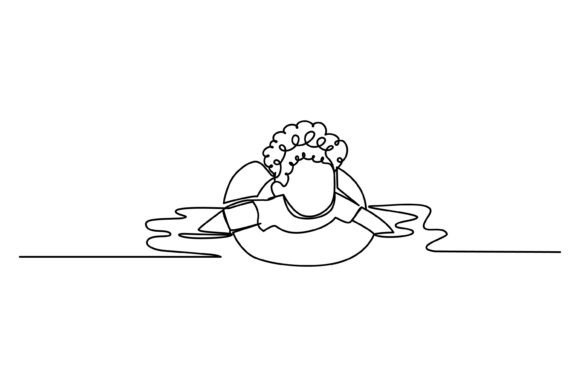
Using a continuous line design of a boy floats in the water using a tire swimming float requires careful consideration of composition. This specific imagery evokes feelings of leisure, summer, childhood innocence, and relaxation. A common oversight is placing such a detailed, emotive illustration against a cluttered background. The strength of single-line art is its negative space. When you crowd it with busy textures or competing fonts, you dilute its impact.
Instead, let the white background work for you. The prompt specifies "single line decorative elements drawn on a white background," which is not just a description but a design directive. White space allows the eye to trace the line effortlessly. If you must add color, do so sparingly. Perhaps use a soft pastel for the tire float or a subtle gradient for the water, but keep the boy’s outline distinct. Over-coloring a minimalist piece often makes it look cheap and defeats the purpose of choosing this sophisticated style.
Evaluating Quality Before Purchase
Before you buy or download any asset, perform a quick quality audit. Look for consistency in line weight. In a high-quality continuous line design, the stroke width should be uniform unless a tapering effect is intentionally stylized. Inconsistent line weights can look like errors rather than artistic choices. Additionally, check the endpoints of the line. They should be rounded or flat depending on your aesthetic preference, but they must be clean. Jagged or uneven ends suggest a low-quality scan or a rushed digital tracing job.
Consider the source’s reputation. Are they providing editable files? Can you separate the elements if needed? For example, in the design of a boy floating on a tire, you might want to adjust the position of the tire relative to the boy. If the file is a flattened image or a grouped vector that cannot be ungrouped, your flexibility is limited. Always read the license agreement as well. Ensure that your intended use—whether commercial advertising, educational materials, or personal blog posts—is covered. Copyright infringements can lead to costly legal issues and removal of your content from platforms.
Practical Application for Different Professionals
For marketers and bloggers, this type of imagery is perfect for headers and social media posts that aim to evoke nostalgia or calm. Use the SVG format to ensure fast loading times, which is crucial for SEO and user experience. For educators and child-focused businesses, the playful nature of a boy on a swim ring can soften serious topics or highlight recreational programs. Here, clarity is key; ensure the line contrasts well against your website’s background color.
Freelancers and small business owners can use these designs to create unique merchandise. Printing a continuous line design on tote bags, t-shirts, or mugs requires high-resolution vector files to avoid pixelation during the printing process. Using the EPS file allows print shops to scale the design to fit various product dimensions without loss of quality. Remember, the perceived value of your product increases when the graphics are sharp and professionally applied.
Avoiding the Trap of Generic Usage
Finally, avoid using these designs in a way that feels generic or disconnected from your message. Because continuous line art is trendy, it is everywhere. To stand out, customize the context. If you are using the image of the boy floating, pair it with copy that speaks to freedom, ease, or taking a break. Do not just drop the image onto a page because it looks nice. Integrate it into your narrative. Adjust the opacity, combine it with typography that complements the thin lines, or use it as a subtle watermark.
In conclusion, a continuous line design of a boy is a powerful visual tool when used correctly. By avoiding common mistakes related to file formats, quality verification, and contextual placement, you elevate your creative projects. Take the time to understand the technical requirements of EPS and SVG files, respect the minimalist aesthetic by utilizing white space, and ensure your usage aligns with licensing terms. These steps will help you leverage this elegant art form to communicate clearly, engage your audience, and maintain a high standard of professional design.